
Voice shift handover
Hand over your shift out loud.
Nothing left behind.
The shift lead talks with Tino for a few minutes at the end of the shift. The conversation becomes a report, they approve it, and the next shift already knows what's open.
 Shift B handover

The problem
Every plant loses its memory every 8 hours.
The handover in a notebook, spreadsheet, or form gets filled in a rush by a tired lead, and the next shift almost never reads it. What really happened walks out the door with whoever left.
The same event, recorded two ways:
Notebook · Shift B · 10:07 PM
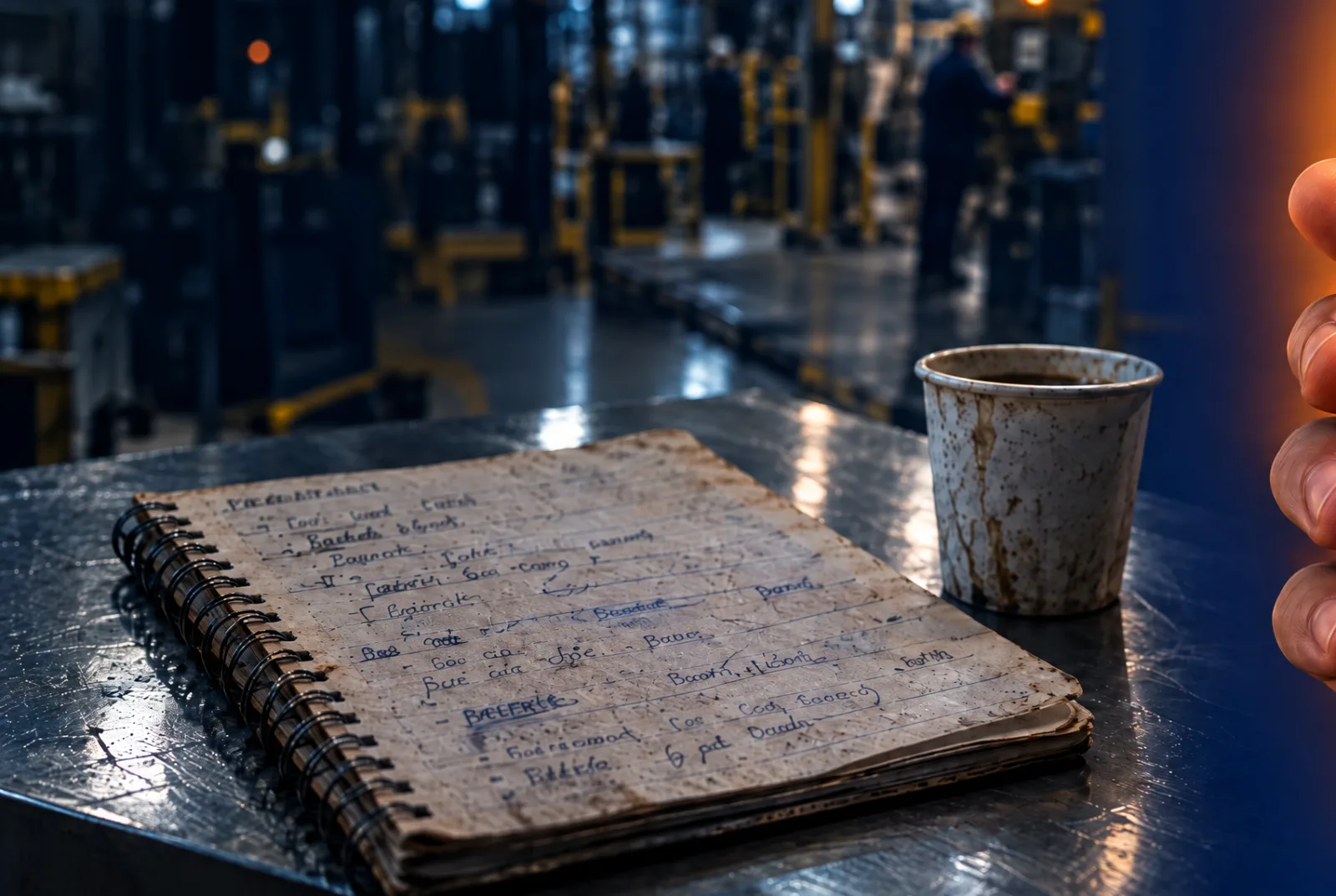
Two lines. “Press 2 vibrating, check tomorrow.”
Tino's record · Shift B · Sep 16 · 9:52 PM · by voice
- Asset
- Press 2
- Area
- Maintenance
- What
- Vibration above normal since 7 PM
- Action
- WO 4471 opened; maintenance coming first thing tomorrow
- Priority
- Urgent
- For the next shift
- Watch the vibration; stop if it goes past the limit
Transcript
“Press 2 started vibrating around seven, I opened the WO, maintenance is coming first thing tomorrow, tell Shift C to keep an eye on it.”
The notebook doesn't tell what happened. Tino does.
- Memory
- The notebook gets the bare minimum, “for the record.” What really happened leaves with whoever left.
- Detail
- End of shift, hands full, in a hurry. The cause of the stoppage, the part you were watching, what you agreed with maintenance: none of it fits in two lines.
- Search
- Two weeks later, someone asks what happened on Line 3. Nobody can find it. Nobody remembers. The problem comes back.
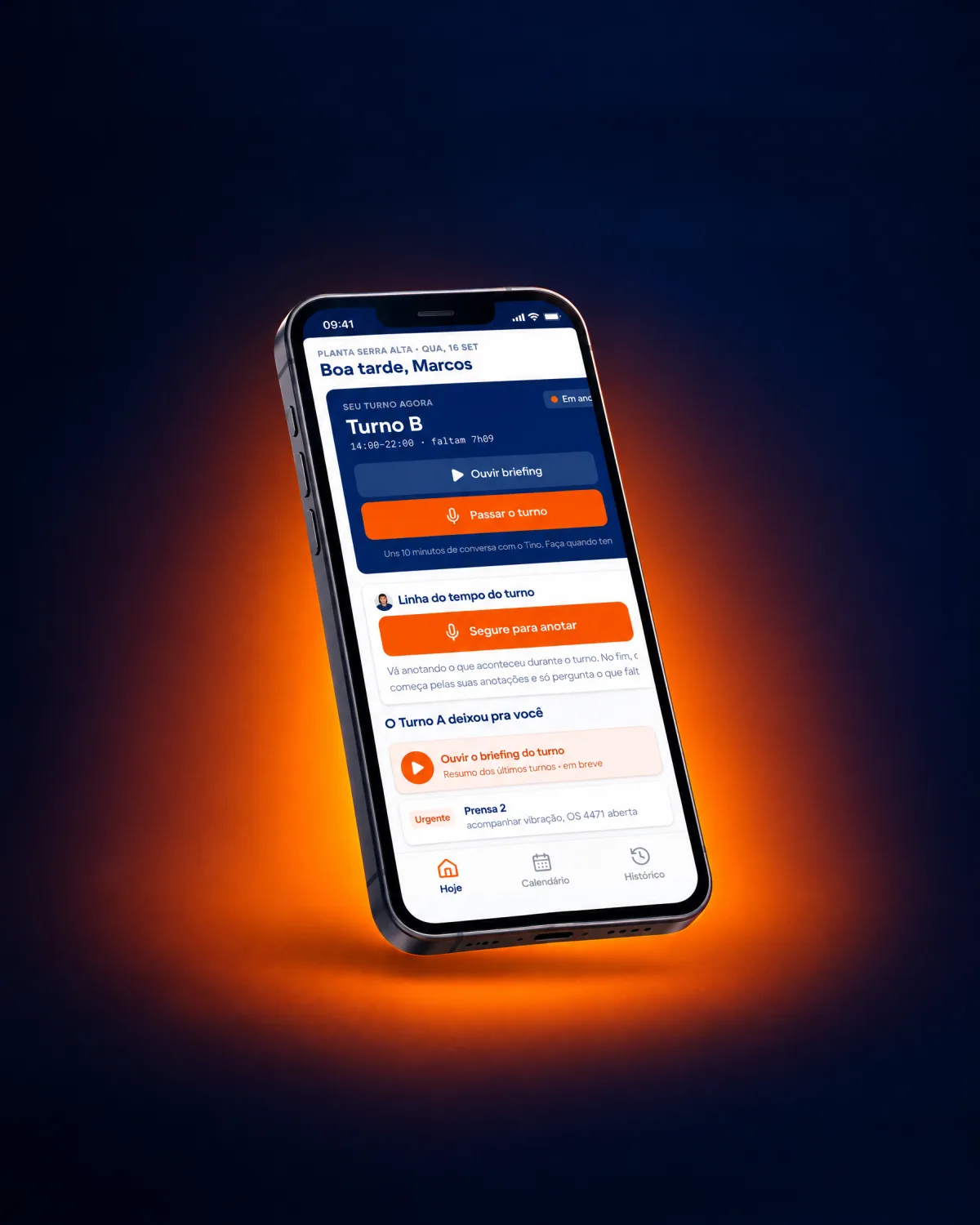
Finding out about the last shift's problem at 3 a.m.? Never again.
Whatever the last shift left open shows up for the incoming lead before the shift starts, with what was done and what's still pending. No surprises.
How it works
Three steps. No forms.
- 01
Take voice notes during the shift
It happened, you pressed, you talked. Tino saves it and sorts it on the spot: area, asset, urgency.
Shift B · 2:00 PM to 10:00 PMOn shiftHold to take a note“Line 1 was down about 12 minutes, conveyor sensor.”
Note saved and sorted3:20 PMLine 1 down, 12 min, conveyor sensorProductionLine 1Normal - 02
Hand over the shift with Tino
At the end, a 5-to-12-minute conversation. He starts from your notes and only asks about what's missing. He brings up the previous shift's open items and confirms what carries over to the next one.
Handover with Tino · 9:50 PM6:42You noted the Line 1 stop and the Press 2 vibration. Anything left on quality?
Lot 0915 was held by quality, waiting on the lab report.
Noted. The previous shift left Forklift 3 waiting on a brake repair. Still the case?
You - 03
Review, approve, done
The draft shows up in the app. You adjust whatever you want, approve, and the report goes out by email to whoever needs it. The incoming lead opens the app and sees what's open.
Report · Shift B · Sep 16Draft- Production
- 1 stop, 12 min
- Maintenance
- Press 2 · WO 4471Urgent
- Quality
- lot 0915 held
- Open items
- 2 for Shift C
Approve and sendGoes out by email to whoever you choose
“Line 1 was down about 12 minutes, conveyor sensor.”
Shift timeline · Shift B · Sep 16
voice note
- 2:00 PMshift start
- 3:20 PM · voice noteLine 1 down, 12 min, conveyor sensorProduction
- 5:45 PM · voice notelot 0915 held by qualityQuality
- 7:10 PM · voice notePress 2 vibrating, WO 4471Maintenance
- 9:50 PMhandover with Tino
- 10:00 PMreport approved → email sent
Why voice
Talking is faster than writing. And what comes out isn't loose audio: it's structured data, which gives the next lead a briefing, gives you a searchable history, and lets trends show.
For management
What management starts to see.
Every shift becomes structured data. Everything else comes from there.
- Ask the history like you'd ask a coworker. It answers only with what was recorded.
- Open items that don't get lost between shifts: whatever's open stays visible until someone closes it.
- A report by email on every approval, to whoever you choose.
- 24-hour, weekly, and monthly reports on the same data.coming soon
- Audio briefing for the incoming lead, summarizing the last shifts.coming soon
Open items by asset
- UrgentPress 2vibration, WO 4471 open
- UrgentForklift 3waiting on brake repair
- NormalLine 1lot 0915 blocked by quality
Two stoppages: Tuesday (Shift B, 40 min, conveyor sensor) and Thursday (Shift A, 15 min, lot changeover adjustment). Maintenance replaced the sensor on Wednesday. No open items today.

Who Tino is
A WC MAC coworker stationed at your plant.
Tino isn't a form. He's someone who asks, listens, confirms what he understood, and writes it down. He doesn't judge, doesn't police, doesn't give advice. He speaks the plant's language, one language only, and knows what the previous shift left open.
Tino · end of Shift B“Before we wrap up: Press 2 is still vibrating and WO 4471 is open. Anything else for the next shift?”
Who's behind it
- Since 1996
- WC MAC on plant floors
- 400+
- plants served
- 11 countries
- with projects delivered
Spec sheet
Built for the plant floor, with care.
- Approval
- always human, by the lead who ran the shift
- Names in safety
- never; area or role only
- Data
- isolated per plant, from day one
- Access
- by invitation; lead, manager, and admin roles
- Language
- one per plant, no switching mid-conversation
- Runs on
- phone or computer, nothing to install
- Report
- by email on every approval
Objections, head-on
What every plant manager asks.
- “My shift leads won't talk to a robot.”
- Tino is introduced as a WC MAC coworker stationed at the plant, and the conversation is the same one they already have in the locker room. It takes less time than filling in the notebook. And nothing goes out without their review.
- “Plants are loud.”
- The handover happens at the end of the shift, in an office or locker room, on the phone. Notes during the shift work with the phone close to your mouth. In the pilot, we test with your plant's real audio before scaling up.
- “It's one more system to feed.”
- There's no form. The lead talks, Tino structures. Whoever gets the report gets it by email, no login needed.
- “How much of the lead's time does it take?”
- A 5-to-12-minute conversation at the end of the shift. Less if they took notes during the shift.
- “What if Tino gets it wrong?”
- Before wrapping up, he reads back what he recorded. Then the lead reviews the draft and only then approves it.
- “Does it integrate with our ERP/MES?”
- Not yet, and the pilot doesn't depend on it. The report goes out by email and the history stays searchable in the app.
“My shift leads won't talk to a robot.”
Tino is introduced as a WC MAC coworker stationed at the plant, and the conversation is the same one they already have in the locker room. It takes less time than filling in the notebook. And nothing goes out without their review.
“Plants are loud.”
The handover happens at the end of the shift, in an office or locker room, on the phone. Notes during the shift work with the phone close to your mouth. In the pilot, we test with your plant's real audio before scaling up.
“It's one more system to feed.”
There's no form. The lead talks, Tino structures. Whoever gets the report gets it by email, no login needed.
“How much of the lead's time does it take?”
A 5-to-12-minute conversation at the end of the shift. Less if they took notes during the shift.
“What if Tino gets it wrong?”
Before wrapping up, he reads back what he recorded. Then the lead reviews the draft and only then approves it.
“Does it integrate with our ERP/MES?”
Not yet, and the pilot doesn't depend on it. The report goes out by email and the history stays searchable in the app.

The shift is over. Nothing left behind.
Want to try it at your plant?
A pilot on one shift, two weeks. We set up the shifts, invite the leads, and follow along with you.